
3(16) Fiduciary Services & Plan Administrator
The fiduciary is the entity or person responsible for overseeing the plan’s administration and selecting investment options. Every retirement plan must have at least one named fiduciary. For most, the business owner or sponsor serves that role and is always considered a fiduciary, regardless of other named fiduciaries in the plan document or anyone hired to assist him or her with his or her duties.
Benefits of Hiring TRA as a Delegated 3(16) Plan Administrator
You may choose our TPA Solutions to serve as a delegated 3(16) plan administrator providing 3(16) fiduciary services. We relieve the business owner or sponsor of many of the day-to-day administrative burdens associated with sponsoring a plan.
Benefits include:
- Time savings
- Reduced liability
- Increased human resources capacity
- Reduced audit risk
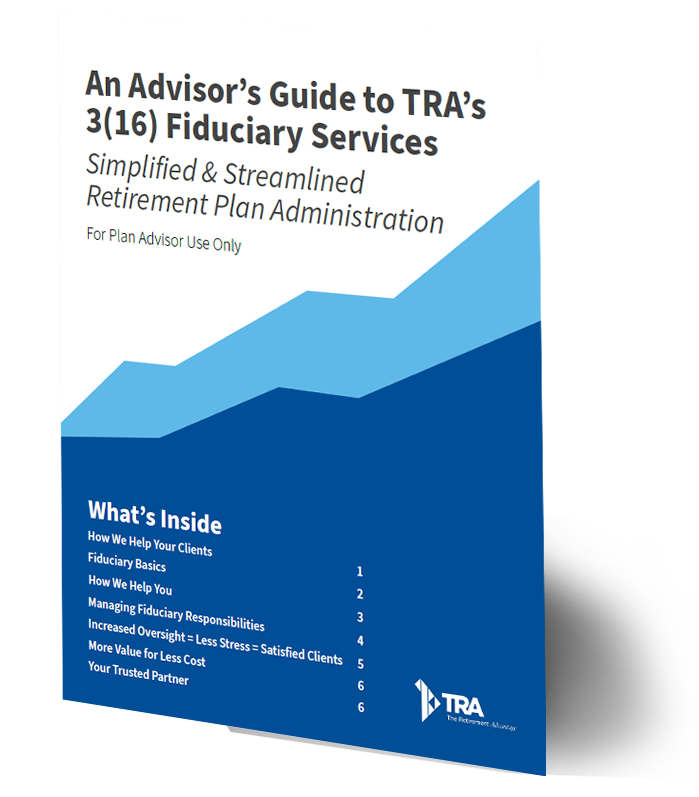 Download a comprehensive advisor guide
for TRA’s 3(16) Fiduciary Services.
FIDUCIARY RESPONSIBILITY TO MONITOR
| Common Plan Audit Failures | Without TRA | With TRA’s 3(16) Services |
|---|---|---|
| Failure to update plan document | Plan sponsor | TRA – Enhanced |
| Failure to follow the terms of the plan document | Plan sponsor | TRA – Enhanced |
| Incorrect eligibility determination | Plan sponsor | TRA – Enhanced |
| Incorrect hardship withdrawal approvals | Plan sponsor | TRA – Enhanced/Core |
| Incorrect application of loan provisions | Plan sponsor | TRA – Enhanced |
| Failure to make required contributions | Plan sponsor | TRA – Enhanced |
| Failure to file Form 5500 | Plan sponsor | TRA – Enhanced/Core |
| Uncorrected testing failures | Plan sponsor | TRA – Enhanced |
| Untimely or failure to send required notices | Plan sponsor | TRA – Enhanced |
| Failure to manage involuntary distributions | Plan sponsor | TRA – Enhanced |
Download the most common plan audit failures.
Click Here to to view the Data Collection Requirements.
ADMINISTRATION SERVICES & 3(16) FIDUCIARY SERVICES
| Standard TPA Services | 3(16) Core Fiduciary Services | 3(16) Enhanced Fiduciary Services | |
|---|---|---|---|
| Custom plan design and consulting | X | X | X |
| Draft plan document and Summary Plan Description | X | X | X |
| Update plan document for IRS/DOL laws | X | X | X |
| Verify required annual employer contributions | X | X | X |
| Allocate year-end contributions and forfeitures | X | X | X |
| Complete year-end required compliance testing | X | X | X |
| Prepare Form 5500 | X | X | X |
| Prepare participant notices and disclosures | X | X | X |
| Interpret plan document | X | ||
| Notify plan administrator of any observed plan irregularities | X | ||
| The Fidelity Bond Purchase Program (FBPP) secures a 3-year ERISA Fidelity Bond*** | X | X | |
| Administer loan policy | X | ||
| Approve corrective refunds | X | X | |
| Approve hardship withdrawals | X | X | |
| Approve in-service withdrawals | X | X | |
| Approve loans | X | X | |
| Approve Qualified Domestic Relations Order (QDRO) | X | X | |
| Approve Required Minimum Distributions | X | X | |
| Approve separation of service distributions | X | X | |
| Monitor loan defaults | X | ||
| Reconcile participant level contributions with plan trust | X | ||
| Determine eligibility * | X | ||
| Review and upload vesting to plan providers | X | ||
| Search for missing terminated participants (as necessary | X | ||
| Deliver distribution packages to lingering terminated participants | X | ||
| Mail notices and disclosures to newly eligible employees | X | ||
| Mail blackout notices to participants (as necessary)** | X | ||
| Mail annual notices and disclosures to eligible employees | X | ||
| Sign and file Form 5500 | X | X | |
| Sign and file Form 8955-SSA (if applicable) | X | X | |
| Review large plan Form 5500 and audit report (if applicable) | X | X | |
| Manage involuntary distribution of small balances (force-outs) | X | ||
| Monitor missing beneficiary designations (if applicable) | X |
* If using TRA approved payroll partner or client provides employee census on per payroll basis
** Blackout notices will be the responsibility of the company during the installation process
***Only available for Start-up Plans electing 3(16) Services
Download 3(16) compliance and administration service levels.
TRA 3(16) Fiduciary Services Frequently Asked Questions (FAQ's)
-
-
▾
What does a 3(16) fiduciary do for an employer?
A 3(16) fiduciary takes on selected day-to-day retirement plan administrative responsibilities, such as overseeing notices, distributions, eligibility, and certain filings. For employers, that can mean less internal administrative burden and stronger operational oversight based on the services delegated on the plan.
-
▾
Does a 3(16) fiduciary reduce employer liability?
A 3(16) fiduciary can reduce an employer’s liability for the administrative duties formally delegated under the service agreement. However, the employer still has a responsibility to prudently select and monitor the provider.
-
▾
Why do employers hire a 3(16) fiduciary?
Many employers hire a 3(16) fiduciary to save time, reduce administrative strain on HR teams, improve consistency in plan operations, and lower risk tied to day-to-day plan administration. This is often especially valuable when internal resources are limited.
-
▾
What is the difference between a TPA and a 3(16) fiduciary?
A traditional TPA typically supports plan administration and compliance testing, while a 3(16) fiduciary can take on certain administrative fiduciary responsibilities. In other words, a 3(16) arrangement may go beyond support and include delegated responsibility for specific plan functions.
-
▾
Should a financial advisor recommend 3(16) fiduciary services to a client?
For some clients, yes. A 3(16) fiduciary may be a strong fit when the employer wants to reduce administrative burden, improve process oversight, and address common operational risk areas such as notices, distributions, eligibility, and filing responsibilities.
-
▾
Can a 3(16) fiduciary help with retirement plan compliance?
Yes. A 3(16) fiduciary can help support compliance by overseeing important administrative processes and helping reduce common operational failures. This can help employers maintain more consistent plan administration and reduce audit-related risk.
-
▾
Is a business owner still a fiduciary after hiring a 3(16) provider?
Yes. In most cases, the business owner or plan sponsor still remains a fiduciary even after hiring a 3(16) provider. Delegating responsibilities can shift certain duties, but it does not remove the employer’s obligation to monitor the provider.
-
To learn more about TRA’s 3(16) service, watch the video below.